GST-Free vs Input-Taxed Supplies: Why the Distinction Matters for Your BAS
Not all "no GST" transactions are treated the same way — and confusing the two most common categories, GST-free and input-taxed supplies, is one of the most frequent errors we see on a Business Activity Statement.
The difference sounds technical, but it has a direct financial impact: get it wrong, and a business can either underclaim GST credits it's entitled to, or overclaim credits it isn't — both of which create problems at reconciliation or review time.
The Core Difference
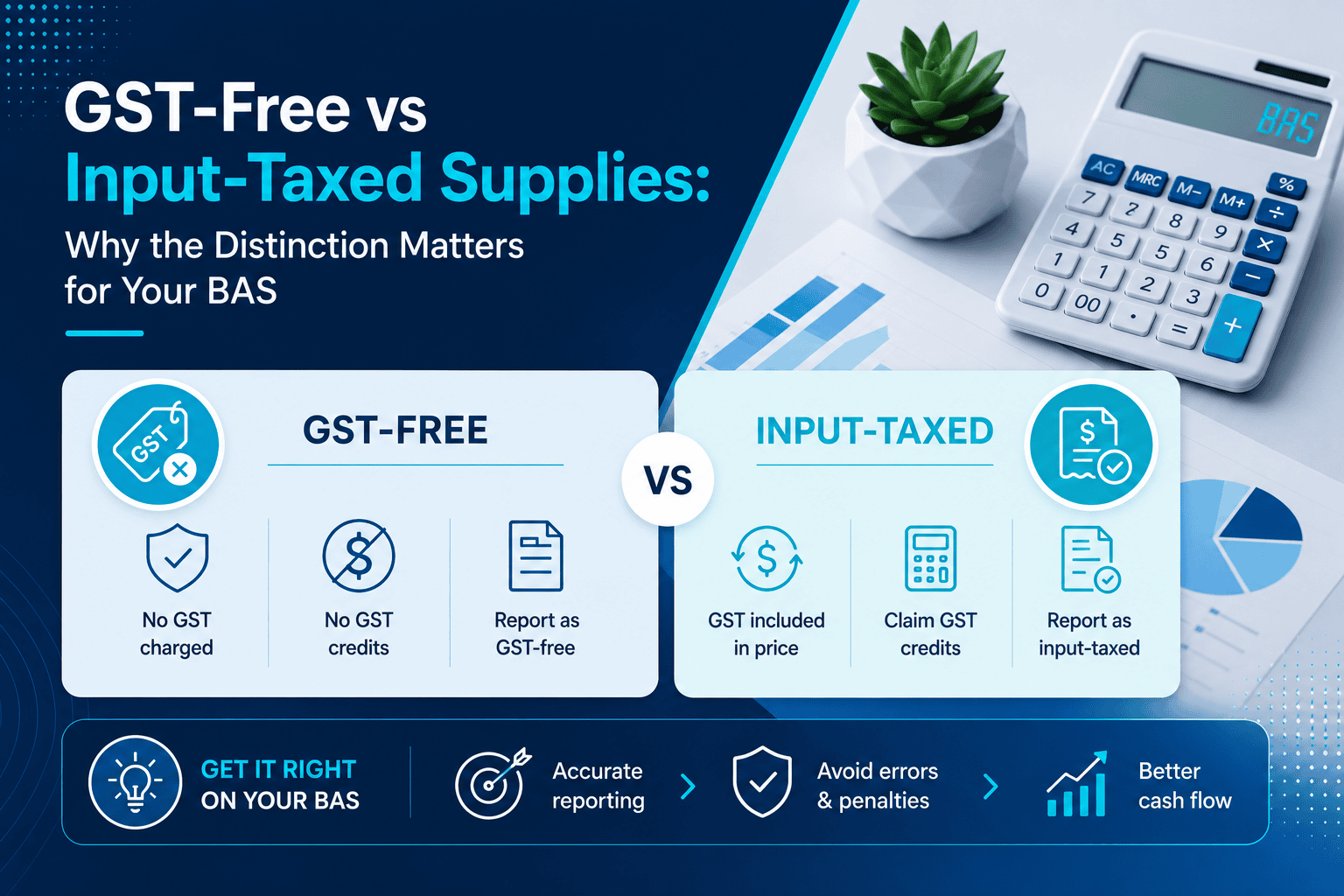
Both GST-free and input-taxed supplies mean no GST is charged on the sale. That's where the similarity ends.
GST-free supplies:
- No GST is charged on the sale.
- The business can still claim GST credits on related purchases and expenses used to make that supply.
Input-taxed supplies:
- No GST is charged on the sale.
- The business cannot claim GST credits on related purchases and expenses used to make that supply.
This is the part that catches businesses out — assuming that because no GST applies to a sale, it doesn't matter for BAS purposes either way. In practice, it directly determines whether input tax credits are recoverable.
Where This Shows Up Most Often

Medical and Health Services
Most medical services are treated as GST-free, not input-taxed. This means a medical practice can generally still claim GST credits on equipment, consumables, rent, and other business inputs, even though patient fees themselves don't attract GST. Practices that mistakenly treat their supplies as input-taxed can end up underclaiming credits they're legitimately entitled to.

Financial Services
Many financial services (such as lending and certain insurance products) are input-taxed, meaning GST credits on related costs are generally not claimable, or only partially claimable under specific apportionment rules.

Residential Rent
Residential rental income is typically input-taxed, meaning GST credits on related property expenses are generally not claimable — a common trap for businesses that also hold residential investment property alongside their main operations.
Education and Childcare
Many education and childcare services are GST-free, similar to health services, meaning related GST credits generally remain claimable.

Exports
Most exported goods and services are GST-free, allowing GST credits on the costs of producing them to still be claimed — an important distinction for businesses selling internationally.
How the Amendment Process Generally Works
Getting the classification wrong doesn't just affect a single transaction — it compounds across every related purchase for that revenue stream:
- Underclaiming credits means paying more GST than necessary, quarter after quarter, on legitimate business inputs.
- Overclaiming credits creates a liability that surfaces at reconciliation, audit, or year-end review — often with interest attached.
- Mixed-supply businesses (for example, a practice offering both GST-free medical services and taxable retail products) need to apportion correctly, which requires the underlying classification to be right in the first place.
What to Check in Your Own Business
Getting the classification right, not just the lodgement
A BAS that's lodged on time but built on the wrong GST classification still creates risk — it just surfaces later, usually at review or reconciliation. Getting the underlying classification right the first time protects both your GST position and your credit entitlements.
RBizz reviews GST treatment across your revenue streams to make sure your BAS reflects what you're actually entitled to claim — schedule a free consultation.