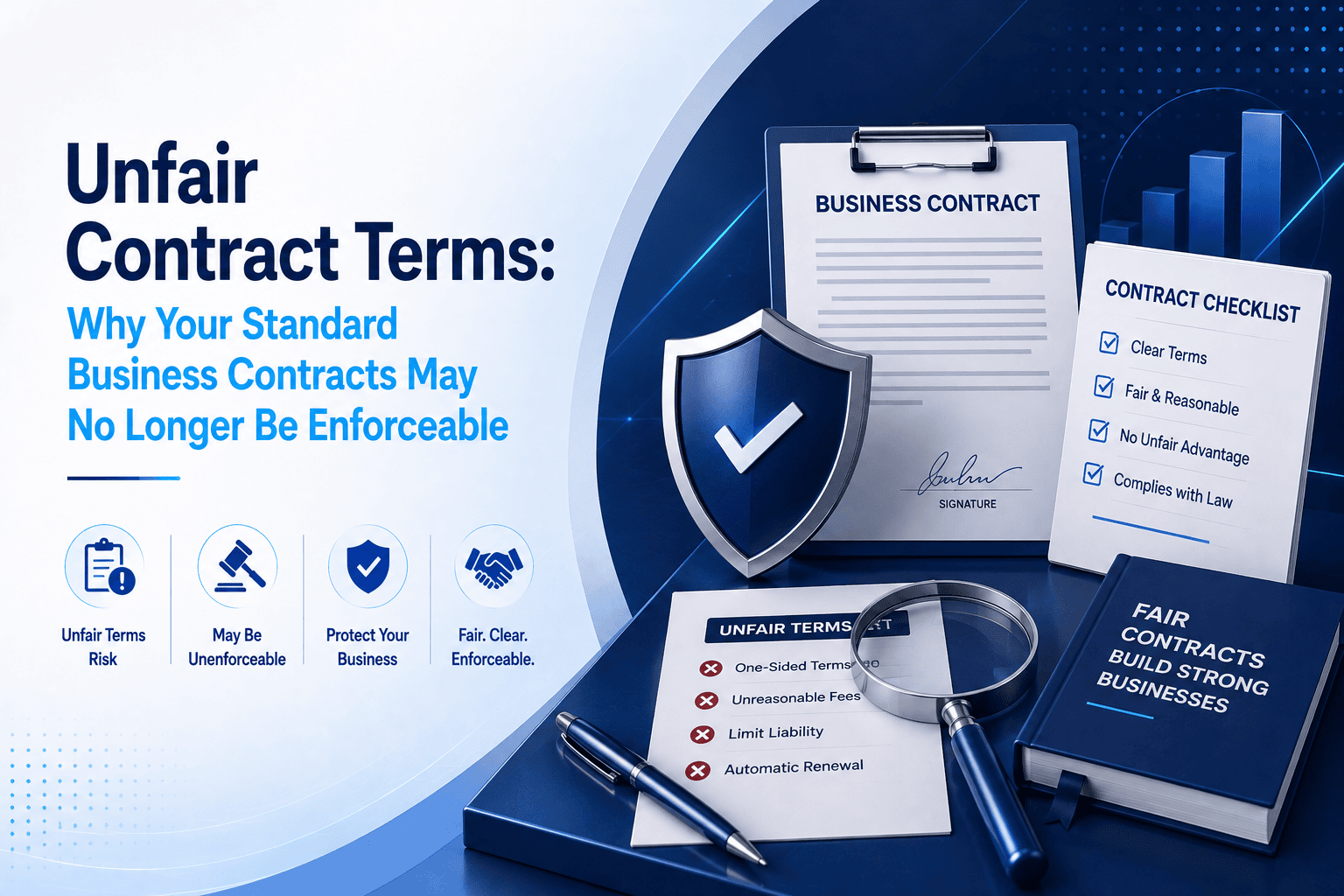
Unfair Contract Terms: Why Your Standard Business Contracts May No Longer Be Enforceable

19/08/2026 02:53 PM
Unfair Contract Terms: Why Your Standard Business Contracts May No Longer Be Enforceable

Unfair Contract Terms: Why Your Standard Business Contracts May No Longer Be Enforceable

Since 9 November 2023, unfair contract term protections for small businesses were significantly expanded, and — critically — including an unfair term in a standard form contract now carries direct financial penalties, not just the risk that the term itself is unenforceable. If your business hasn't reviewed its standard supplier, customer, or service contracts since this change, there's a real chance you're currently using terms that expose the business to penalty, not just risk having a clause struck out if challenged.

What Changed

Before this reform, a term found to be "unfair" in a small business contract was simply void — unenforceable, but without any separate penalty for having included it. The updated law changed this meaningfully: a business (or individual) that proposes, applies, or relies on an unfair contract term in a standard form small business contract can now face substantial financial penalties, in addition to the term itself being unenforceable.

Who's Actually Covered

The expanded protections apply to a "standard form small business contract" — broadly, a contract where:

  • At least one party is a small business (the eligibility test was broadened as part of this reform to capture a larger range of businesses than previously covered)
  • The contract is a "standard form" contract — generally meaning one party has significantly more bargaining power and the contract is offered on a take-it-or-leave-it basis, without genuine negotiation of the specific terms

Many businesses assume unfair contract term protections are something that applies to consumer contracts and doesn't touch their B2B supplier or customer agreements. That assumption is incorrect — a standard form contract between two businesses can absolutely be captured, particularly where a larger business is contracting with a smaller one on its own standard terms.

What Makes a Term "Unfair"

  • A term is generally considered unfair if it would cause a significant imbalance in the parties' rights and obligations, isn't reasonably necessary to protect the legitimate interests of the party who'd benefit from it, and would cause detriment to the other party if relied upon. Common examples of terms that have been found unfair in this context include:

    • Terms allowing one party to unilaterally vary the contract without a corresponding right for the other party
    • Terms allowing one party to terminate for convenience while the other party has no equivalent right
    • Automatic renewal clauses with limited notice periods to opt out
    • Terms that limit one party's liability broadly while imposing extensive liability on the other
    • Terms allowing one party to assign the contract freely while restricting the other party from doing the same
  • Where Businesses Commonly Get Caught Out

  • Using standard template contracts drafted years ago, without reviewing them against the expanded protections and broader eligibility test introduced in this reform.
  • Assuming B2B contracts are automatically excluded, when in fact a standard form contract between businesses can be squarely covered if the small business eligibility and standard form tests are met.
  • Not reviewing contracts where the business is the larger party, since the risk of penalty applies specifically to the party proposing or relying on the unfair term — meaning larger businesses contracting with smaller ones carry more direct exposure here.
  • Continuing to use "boilerplate" terms copied from older templates or industry precedents, without checking whether specific clauses (unilateral variation, one-sided termination, broad liability limitation) would now be considered unfair under the current test.
  • What to Actually Check in Your Contracts

  • Identify every standard form contract your business uses with other businesses — supplier agreements, customer terms, service agreements — not just consumer-facing terms.
  • Check whether the small business eligibility test could apply to your counterparties, given the broadened test introduced in this reform.
  • Review specific clauses for imbalance — particularly unilateral variation rights, one-sided termination clauses, and broad liability limitations that don't apply reciprocally.
  • Get contracts reviewed by a commercial lawyer, specifically against the current unfair contract term test, rather than relying on a general sense that "our contracts have always been fine."
  • Update templates going forward, rather than treating this as a one-time historical contract review — new contracts should be drafted with the current test in mind from the outset.
  • The Real Financial Risk Here

    This isn't simply a risk of an unenforceable clause being struck out if a dispute arises — it's now a genuine penalty exposure for including the term in the first place, regardless of whether it's ever actually relied upon in a dispute. This changes the calculation significantly: the cost of a contract review is considerably lower than the cost of a penalty for a term that's been sitting in a standard contract, unnoticed, since before the law changed.

    Review Your Standard Contracts Before They're Reviewed for You

    Given the direct penalty exposure this reform introduced, it's worth having your standard business contracts reviewed against the current unfair contract term test, rather than assuming templates that predate the reform are still compliant.

    RBizz can connect you with commercial lawyers to review your standard contracts against current unfair contract term requirements — get in touch if your templates haven't been reviewed since 2023.


    Contact Us


    RBizz Team