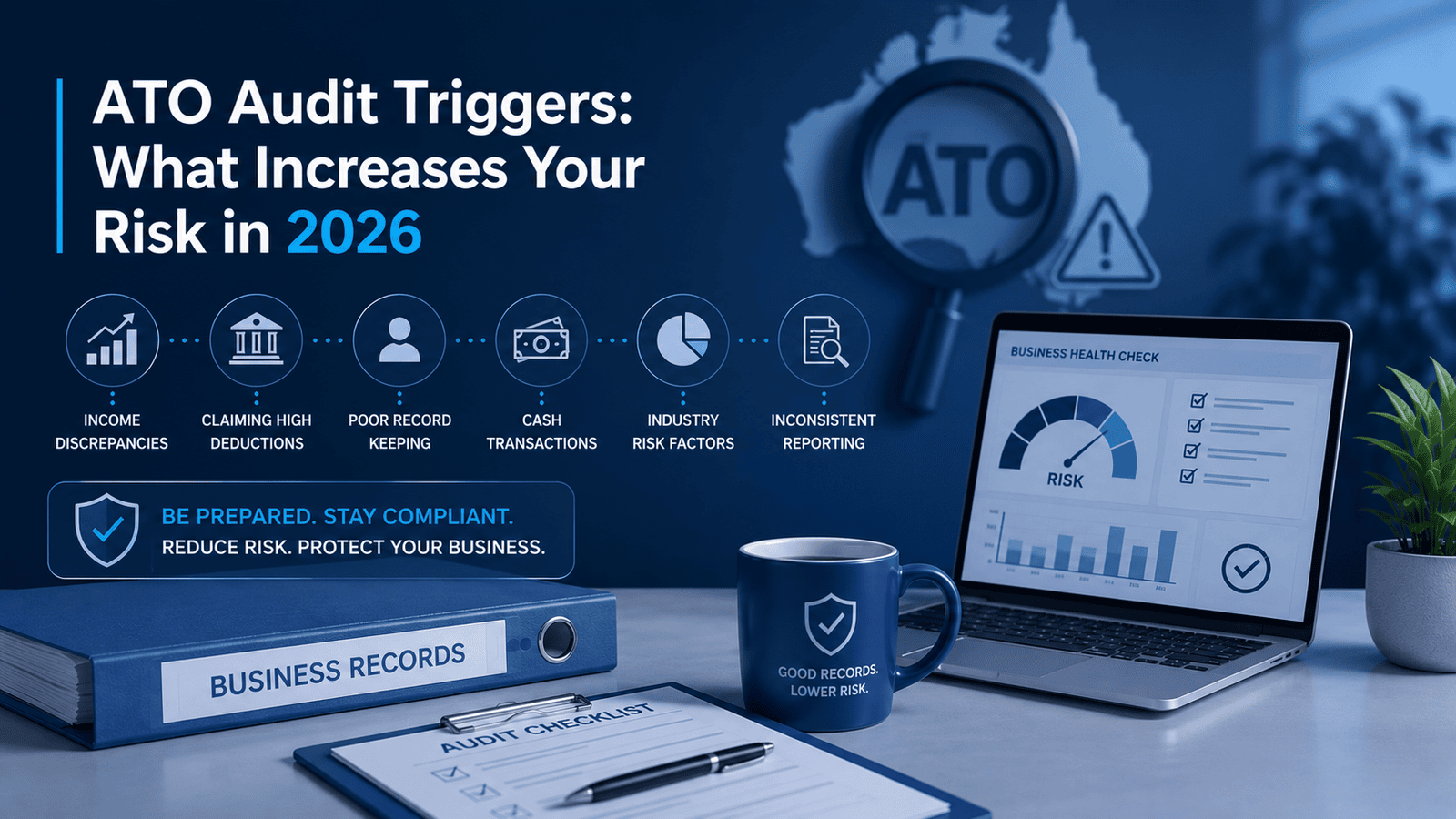
ATO Audit Triggers: What Increases Your Risk in 2026
Very few businesses get audited purely at random. The ATO uses data matching, industry benchmarking, and automated flags to identify returns that warrant a closer look — and understanding what raises that flag is one of the simplest ways to reduce your risk.
Being audited isn't necessarily a sign that something's wrong. But it is time-consuming, and businesses with clean, well-substantiated records go through the process far more smoothly than those without. Here's what typically increases audit risk, and how to stay on the right side of it.
Common Audit Triggers
1. Figures That Sit Outside Industry Benchmarks
The ATO publishes small business benchmarks for many industries, comparing reported income and expenses against typical ranges for similar businesses. A return that sits well outside these ranges — unusually low profit margins, unusually high expense ratios — can attract closer attention.
2. Inconsistencies Between Reports
If your BAS figures, income tax return, and payroll reporting (via Single Touch Payroll) don't align with each other, it creates a visible inconsistency the ATO's systems are specifically designed to catch.
3. Large or Unusual Deductions Relative to Income
A significant jump in claimed deductions — particularly ones without clear substantiation — is a common trigger, especially when it isn't matched by a corresponding change in revenue or business activity.
4. Cash-Heavy Business Models
Businesses in industries where cash transactions are common (hospitality, trades, personal services) face additional scrutiny, simply because underreporting is statistically more common in these sectors. This doesn't mean cash businesses are assumed to be non-compliant — it means recordkeeping matters even more.
5. Related-Party Transactions
Loans between a company and its directors or shareholders, family trust distributions, and related-party rent or service arrangements are all closely monitored, particularly where the terms don't reflect an arm's-length arrangement.
What Reduces Your Risk
None of these triggers mean an audit is guaranteed, and none of them should be avoided by simply not claiming what you're entitled to. The goal isn't to minimise legitimate deductions — it's to make sure everything claimed is properly substantiated.
- Keep documentation for every deduction, not just a receipt but a clear business justification.
- Reconcile BAS, payroll, and tax return figures against each other before lodgment, not after a discrepancy is flagged.
- Document related-party arrangements formally, including loan agreements and market-rate justification for rent or services.
- Lodge on time, consistently, even if the exact figures are still being finalised — amendments are far less disruptive than a pattern of lateness.
- Have a second set of eyes review unusual years — a year with materially different figures from the one before is worth a proactive review, not just a lodgment.
If You Are Selected for Review
Confidence Comes From Preparation, Not Luck
The best defence against audit risk isn't avoiding attention — it's making sure that if attention comes, your records hold up without a scramble.
RBizz reviews client accounts with audit-readiness in mind year-round, not just at tax time — schedule a free consultation to check where your business stands.