
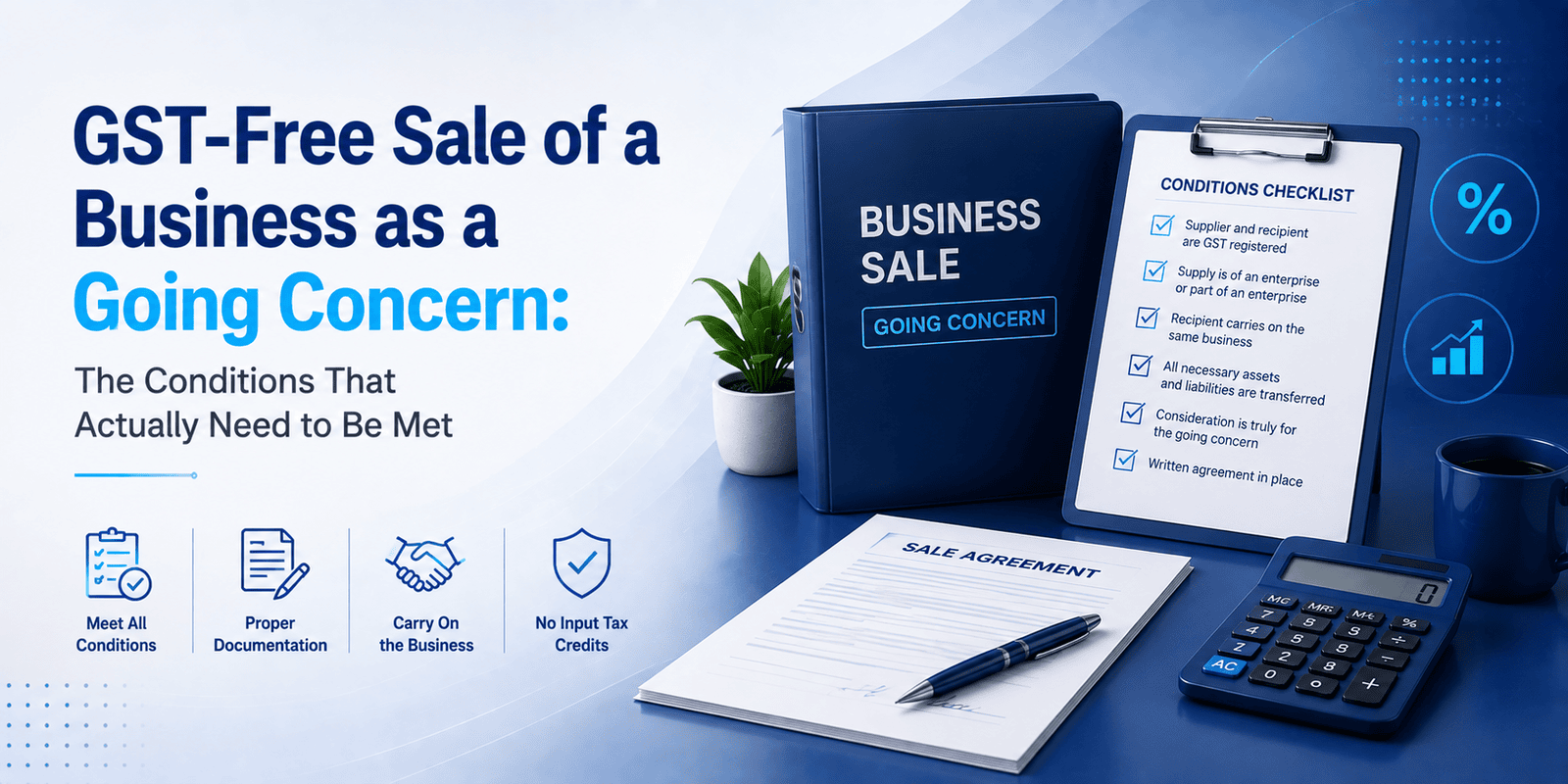
GST-Free Sale of a Business as a Going Concern: The Conditions That Actually Need to Be Met

13/08/2026 04:51 PM
GST-Free Sale of a Business as a Going Concern: The Conditions That Actually Need to Be Met


GST-Free Sale of a Business as a Going Concern: The Conditions That Actually Need to Be Met

Selling a business can potentially be treated as GST-free under the "supply of a going concern" provisions — meaning no GST is charged on the sale price at all. This is a significant cash flow advantage for both parties (the buyer doesn't need to fund the GST upfront, even though they'd normally claim it back eventually). But this treatment only applies if specific conditions are met, and getting even one wrong means the sale is treated as a standard taxable supply, with GST applying to the full price.

What "Going Concern" Actually Means Here

A going concern supply broadly means the sale includes everything necessary for the purchaser to continue operating the business, not just a collection of individual assets. The legal test focuses on whether the seller supplies to the buyer all the things necessary for the continued operation of the business, and the seller carries on the business until the day of the sale.

The Conditions That Must All Be Met

    1. Both parties must be registered for GST. If either the seller or the buyer isn't GST-registered at the time of the sale, the going concern treatment isn't available, regardless of how the rest of the transaction is structured.

    2. The sale must be for consideration. This needs to be a genuine sale for payment — not a gift or a nominal transfer.

    3. The buyer must be registered or required to be registered for GST. This overlaps with the first condition but is worth stating separately: it's specifically the buyer's registration status that matters here, not just their general involvement in business.

    4. The parties must agree in writing that the supply is of a going concern. This isn't optional or implied — it needs to be an explicit written agreement between buyer and seller confirming the going concern treatment is intended to apply. This is commonly addressed directly in the sale contract itself, but needs specific wording, not just a general reference to the sale.

    5. The seller must supply all things necessary for the continued operation of the business. This is the most fact-dependent condition, and where sales most commonly fail the test. If the seller retains a key asset, contract, or right that's genuinely necessary for the business to keep operating (for example, retaining a critical piece of equipment, a key supplier agreement, or specific intellectual property essential to the business), the "all things necessary" test may not be satisfied.

    6. The seller must carry on the business until the day of the sale. If the seller has already wound down, ceased trading, or materially changed the business before the sale completes, this condition can be jeopardised.

Where Sales Commonly Fail This Test

  • Excluding a "necessary" asset from the sale, such as a lease the seller wants to keep, a piece of equipment retained for another purpose, or specific contracts not assigned to the buyer — even where this seems like a minor exclusion to the parties involved.
  • Incomplete or vague written agreement wording, where the contract doesn't clearly and specifically state the parties agree the supply is of a going concern.
  • A gap between ceasing to trade and completing the sale, where the business effectively stopped operating before settlement, undermining the "carry on until the day of sale" condition.
  • One party's GST registration lapsing or not being active at the relevant time, which is worth checking specifically at the settlement date, not just assumed based on general registration history.
  • What Happens If the Conditions Aren't Met

    If the going concern conditions aren't satisfied, the sale is treated as a standard taxable supply — meaning GST applies to the full sale price. This has real financial consequences: the seller needs to remit GST on the sale (even if it wasn't factored into the negotiated price), and the buyer needs to fund that GST upfront, only claiming it back as a credit later, creating a cash flow gap in the transaction that wasn't originally planned for.

    What to Check Before Finalising a Business Sale

  • Confirm both parties are currently registered for GST, checked specifically as of the settlement date, not just at the time of negotiation.
  • Identify everything genuinely necessary for the business to continue operating, and ensure all of it is included in the sale — nothing critical retained by the seller.
  • Include specific, clear written agreement in the sale contract that the supply is intended to be treated as a going concern — don't rely on general contract language.
  • Confirm the business continues trading normally right up until settlement, avoiding an operational gap before the sale completes.
  • Get the GST treatment confirmed by a tax adviser before signing, since correcting a mistaken assumption after settlement is considerably more complicated than confirming it beforehand.
  • Don't Assume Going Concern Treatment Applies — Confirm It

    Given how much difference this makes to the cash flow of a transaction, it's worth having the specific conditions checked against your actual sale structure before contracts are signed, not after.


    RBizz reviews business sale structures to confirm going concern GST treatment applies before settlement — get in touch before you finalise your next transaction.


    Contact Us


    RBizz Team