
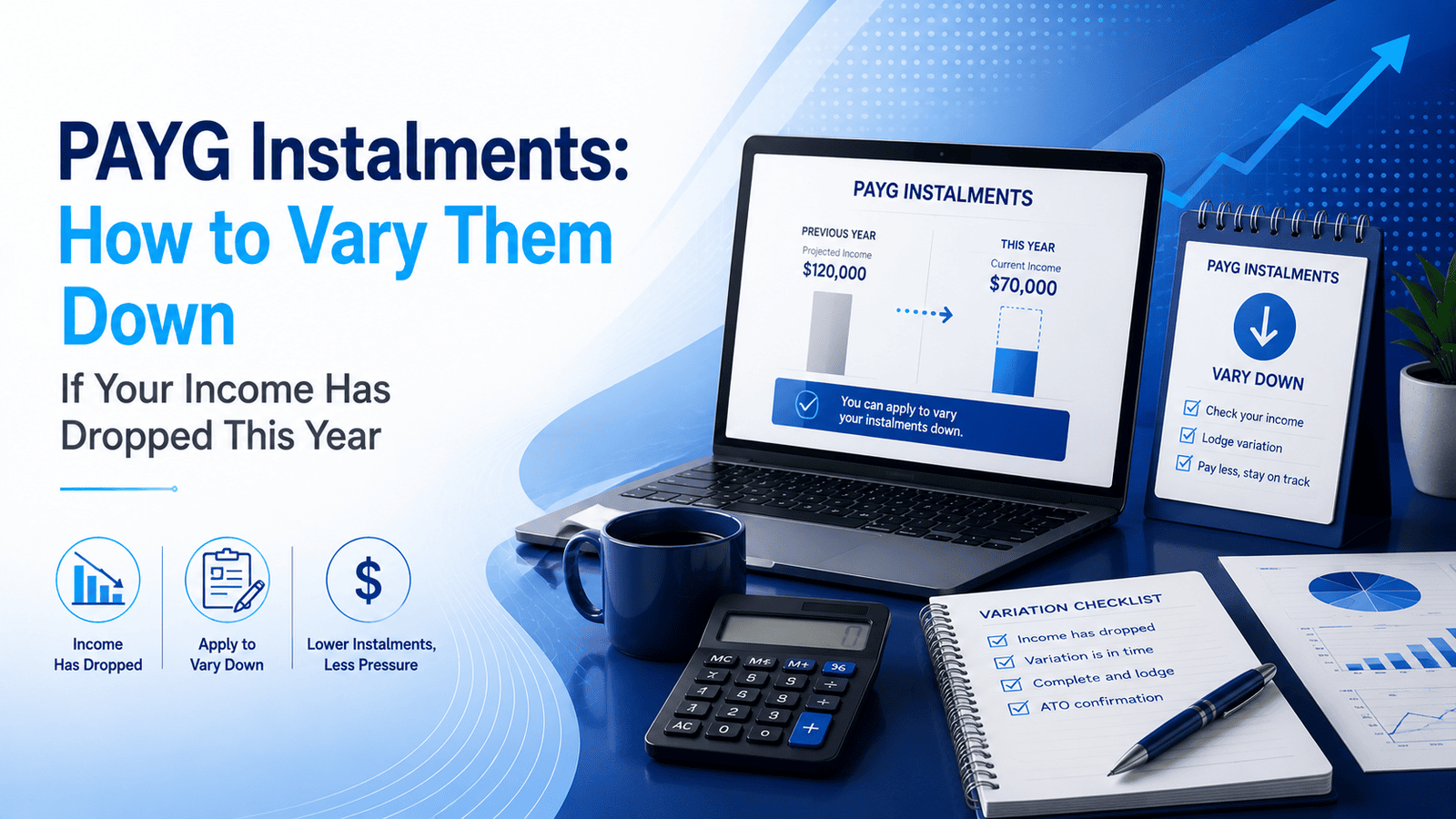
PAYG Instalments: How to Vary Them Down If Your Income Has Dropped This Year

13/08/2026 04:49 PM
PAYG Instalments: How to Vary Them Down If Your Income Has Dropped This Year


PAYG Instalments: How to Vary Them Down If Your Income Has Dropped This Year

PAYG instalments are generally calculated based on your previous year's income — meaning if your business or personal income has dropped materially this year, you could be paying instalments based on a figure that no longer reflects reality. The ATO allows you to vary your instalment amount to better match your actual expected income for the current year, but the variation needs to be calculated properly, because getting it wrong in the wrong direction carries its own penalty.

Why This Happens in the First Place

Your PAYG instalment amount (or rate, if you're using the instalment rate method) is generally set using your most recently assessed tax return. If this year's income is tracking meaningfully lower — due to a slower trading period, a one-off prior-year gain that isn't repeating, or a genuine change in business circumstances — continuing to pay instalments calculated on last year's higher figure means overpaying throughout the year, even though you'll eventually get it back as a refund or credit at tax time.

For businesses managing cash flow carefully, that overpayment sitting with the ATO rather than in your own accounts for months at a time is a real, avoidable cost.

How to Actually Vary an Instalment

You can vary your PAYG instalment amount before it's due, generally through your instalment notice, tax agent, or Online services for individuals or business. The variation requires you to provide a reasonable estimate of your expected tax for the year, which then recalculates your remaining instalments to align with that revised figure.

The Part That Catches People Out: The Penalty for Getting It Wrong

If you vary your instalment down and your estimate turns out to be significantly understated relative to your actual final tax liability, a general interest charge can apply to the shortfall between what you paid through varied instalments and what you should have paid based on your actual result. This is specifically designed to discourage people from varying instalments down aggressively just to improve short-term cash flow, without a genuine basis for the lower estimate.


In practical terms: if you have a reasonable, evidence-based reason for the reduced estimate — a documented drop in revenue, a one-off prior-year item that won't recur, a genuine change in business activity — you're in a defensible position. If you're varying down purely because cash is tight this quarter, without the underlying full-year figures actually supporting a lower liability, you're taking on real risk of a penalty later.

When Varying Down Makes Sense

  • Your revenue has genuinely and materially dropped compared to the year the instalment was based on
  • A one-off item (large capital gain, unusual bonus income, a large one-time contract) inflated last year's figure in a way that won't repeat
  • Your business has undergone a structural change (scaling back, closing a location, losing a major client) with a clear, demonstrable impact on this year's expected income
  • When Varying Down Is Risky

  • Revenue is down temporarily but expected to recover before year-end, meaning your full-year figure may not actually be materially lower
  • You're estimating based on a rough guess rather than an actual review of year-to-date figures and a reasonable forecast for the remainder of the year
  • Multiple income sources exist and only one has dropped, without a full recalculation of total expected income across all sources
  • What to Do Before Submitting a Variation

  • Prepare an actual estimate based on year-to-date figures plus a reasonable forecast, not a rough guess of "business feels slower this year."
  • Document the basis for the reduced estimate, particularly if it relates to a one-off prior-year item or a specific, identifiable change in circumstances.
  • Reassess partway through the year if circumstances change again, since a variation isn't a one-time "set and forget" — if income recovers later in the year, a further adjustment may be needed to avoid ending up understated at year-end.
  • Get the estimate reviewed before submitting, particularly if the variation is substantial, since the general interest charge exposure scales with how far off the final estimate turns out to be.
  • Get Your Instalment Variation Calculated Properly

    If your income has genuinely shifted this year, a properly calculated variation can meaningfully improve your cash flow without creating penalty exposure — but only if the underlying estimate is well-founded.

    RBizz  reviews year-to-date figures and calculates defensible PAYG instalment variations — get in touch before your next instalment is due.


    Contact Us


    RBizz Team