
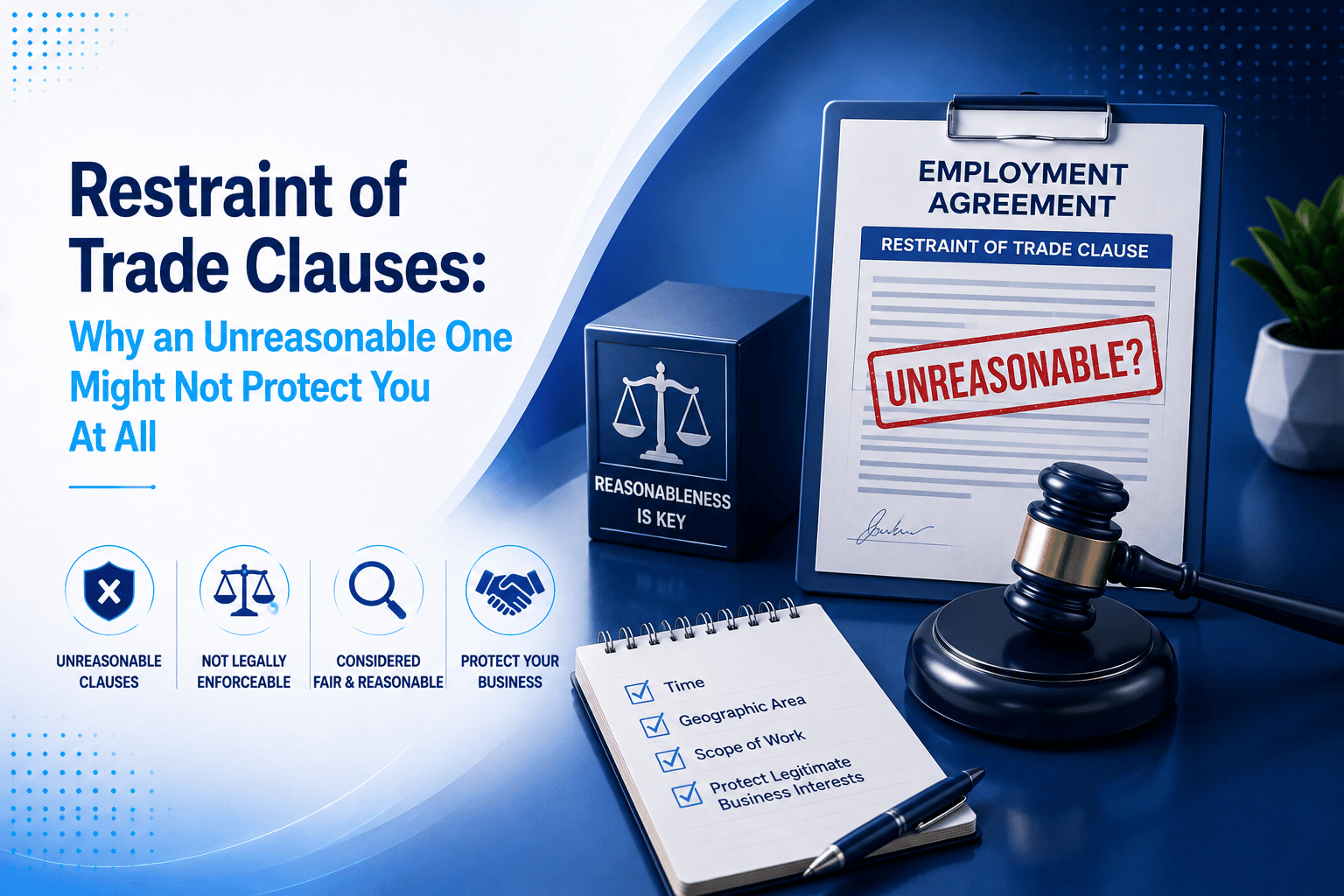
Restraint of Trade Clauses: Why an Unreasonable One Might Not Protect You At All

20/08/2026 07:40 PM
Restraint of Trade Clauses: Why an Unreasonable One Might Not Protect You At All

Restraint of Trade Clauses: Why an Unreasonable One Might Not Protect You At All

Restraint of trade clauses — restricting a departing employee or business partner from competing, soliciting clients, or poaching staff — are common in employment contracts, shareholder agreements, and business sale contracts. But there's a critical, counter-intuitive risk many business owners don't fully appreciate: a restraint clause that's drafted too broadly doesn't just fail to protect you fully — it can be entirely unenforceable, leaving you with no protection at all, not even a scaled-back version.

Why Australian Courts Start From a Position of Suspicion

Restraint of trade clauses restrict a person's ability to earn a living or a business's ability to compete — both things the law generally protects. As a starting position, Australian courts treat restraint of trade clauses as void unless they can be shown to be reasonable, both in the interests of the parties involved and in the broader public interest. This means the burden generally falls on the business seeking to enforce the clause to demonstrate it's reasonable, not on the other party to prove it's unfair.

What Makes a Restraint "Reasonable"

Courts generally assess reasonableness against three main dimensions:

1. Geographic scope — is the restraint limited to an area where the business genuinely operates and has a legitimate interest to protect, or does it extend to areas the business has no genuine presence or connection to?

2. Duration — is the length of the restraint proportionate to the legitimate interest being protected (such as the time it genuinely takes for client relationships or confidential information to lose their competitive sensitivity), or is it excessive relative to that interest?

3. Scope of restricted activity — is the restriction limited to genuinely competing activity relevant to the business's actual operations, or does it extend broadly to any work in a general industry, regardless of whether it actually competes with the specific business?

A restraint that's excessive on any of these dimensions risks being found unreasonable — and depending on how the clause is drafted, an unreasonable restraint isn't always simply narrowed down by a court to a reasonable version. In many cases, particularly with poorly drafted "all-or-nothing" clauses, the entire restraint can be struck out, leaving the business with no restriction at all, even in circumstances where a properly scoped restraint would clearly have been enforceable.

The "Cascading" Clause Approach

Because of this risk, well-drafted restraint clauses are commonly structured with cascading or stepped provisions — offering a series of alternative geographic areas, durations, or scopes of decreasing breadth, expressed so that if the broadest version is found unreasonable, the next narrower version can still be relied upon, and so on down to a clearly reasonable minimum position.

A restraint clause without this cascading structure — a single, fixed geographic area, duration, and scope — carries considerably more risk, since there's no fallback position if a court finds the specific combination unreasonable as drafted.

Where Businesses Commonly Get This Wrong

  • Copying a restraint clause from a template or another business's contract without considering whether the specific scope genuinely reflects this business's actual operations and legitimate interests.
  • Drafting an overly broad restraint "just to be safe," without realising this approach increases the risk of the clause being struck out entirely, rather than simply being narrowed if challenged.
  • Not including a cascading structure, leaving a single restraint provision with no fallback if the primary scope is found excessive.
  • Applying the same restraint terms to every employee regardless of seniority or role, when a restraint reasonable for a senior executive with access to strategic information may be considerably harder to justify for a junior employee without equivalent access or influence.
  • Not revisiting restraint clauses as the business grows, since a restraint scope reasonable for a business's original geographic footprint may need updating (or may become harder to justify as overly broad) as the business's actual operations expand or contract.
  • What to Check in Your Current Contracts

  • Review whether restraint clauses include a cascading structure, providing fallback positions if the broadest scope is challenged.
  • Assess whether the geographic scope genuinely reflects where the business actually operates, rather than an arbitrarily broad area.
  • Check whether restraint duration is proportionate to the specific interest being protected, rather than a standard "one size fits all" period applied regardless of role.
  • Confirm restraint scope varies appropriately by seniority and role, rather than applying identical terms to every employee regardless of their actual access to sensitive information or client relationships.
  • Get restraint clauses reviewed by an employment lawyer, particularly for senior hires, business sales, or shareholder agreements where the restraint is genuinely important to the transaction.
  • A Restraint Clause Is Only as Good as Its Drafting

    The instinct to draft a broad, all-encompassing restraint clause "for maximum protection" is understandable, but it's frequently the opposite of what actually provides protection. A properly scoped, reasonable restraint — ideally with a cascading fallback structure — is considerably more likely to actually be enforceable than an overly broad one that a court might strike out entirely.

    RBizz can connect you with employment lawyers to review restraint of trade clauses in your contracts and agreements — get in touch before your next key hire or business transaction.


    Contact Us


    RBizz Team