
Superannuation Contribution Caps: Concessional vs Non-Concessional, and What Happens If You Go Over
Concessional Contributions
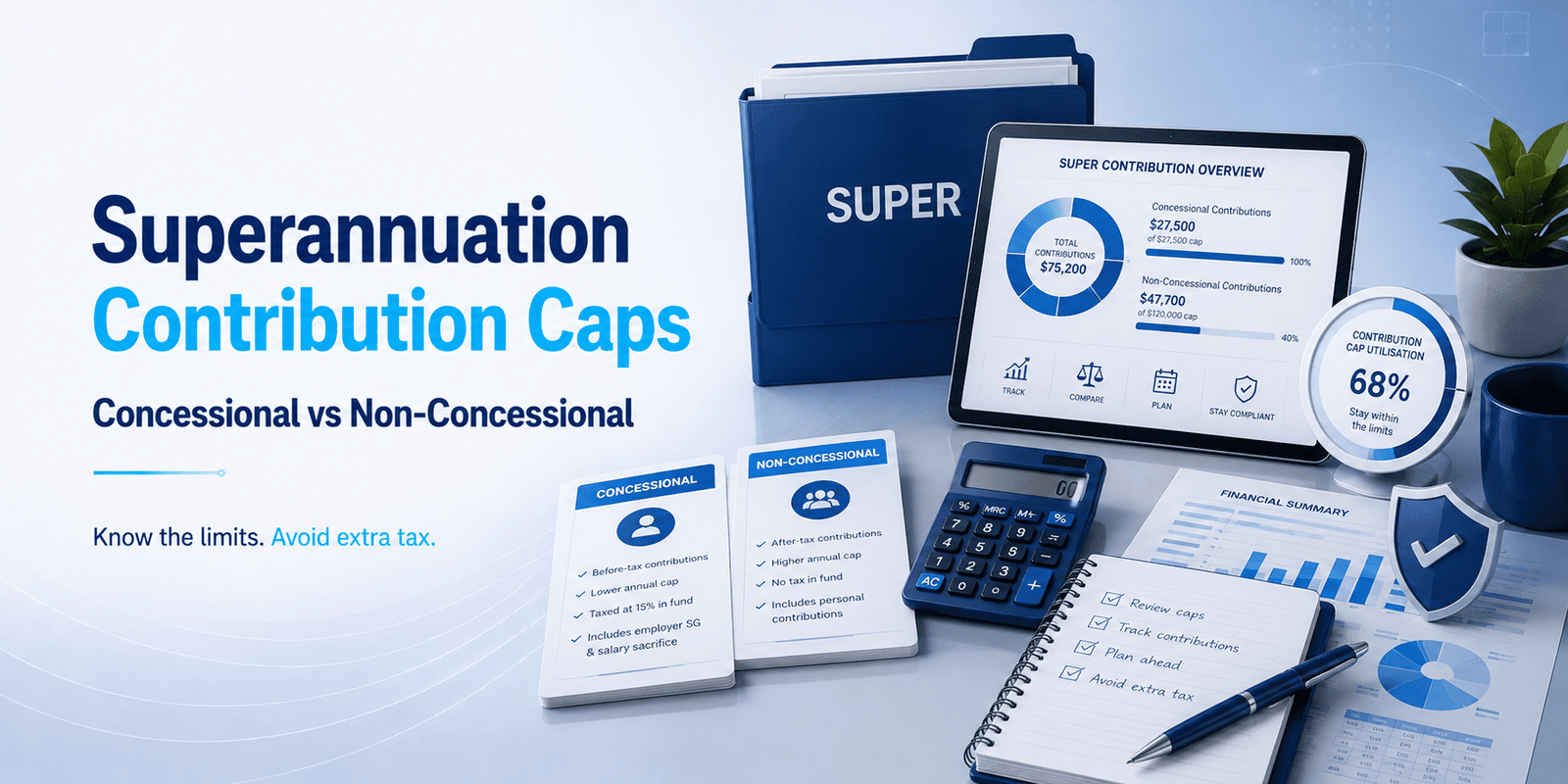
Concessional contributions are made from before-tax income and are taxed within the super fund at a concessional rate. This category includes:
- Employer Superannuation Guarantee contributions
- Salary sacrifice contributions
- Personal contributions you claim a tax deduction for The general concessional cap is $30,000 per financial year (this figure is indexed periodically, so confirm the current year's cap before relying on it).
Carry-forward (catch-up) contributions: if your total super balance was below $500,000 at the end of the previous financial year, you may be able to use unused concessional cap amounts from the previous five years, on top of the current year's cap. This is genuinely useful for business owners who had a lean year followed by a strong one, but it needs to be tracked carefully — the unused amounts expire after five years if not used.
Non-Concessional Contributions
Non-concessional contributions are made from after-tax income — money you've already paid tax on — and are not taxed again within the fund on entry.
The general non-concessional cap is $120,000 per financial year.
The bring-forward rule: if you're under age 75 at some point during the financial year, you may be able to bring forward up to two additional years of non-concessional cap, allowing a contribution of up to $360,000 in a single year (three years' worth combined). Once you trigger the bring-forward, your cap for the following two years is reduced accordingly — you can't then also use each of those years' full caps again.
Total super balance restrictions: your total super balance affects how much (if any) non-concessional cap you have access to. As your total super balance approaches or exceeds certain high thresholds, your non-concessional cap can be reduced to a lower amount, or to zero entirely — meaning a further non-concessional contribution wouldn't be permitted at all.
What Actually Happens If You Exceed a Cap
Exceeding the concessional cap: The excess amount is included in your assessable income and taxed at your marginal tax rate, with a credit for the 15% tax already paid within the fund. You'll also generally be liable for an excess concessional contributions charge, which is effectively an interest charge reflecting the fact that this tax wasn't paid at the time the income would ordinarily have been taxed.
Exceeding the non-concessional cap: This is treated more strictly. Excess non-concessional contributions can be taxed at the top marginal rate if left in the fund, though you generally have the option to withdraw the excess (plus associated earnings) from your fund instead — in which case the associated earnings are included in your assessable income, but the excess contribution amount itself is not further taxed. Failing to act on an excess non-concessional contribution notice within the required timeframe generally results in the harsher default tax treatment applying.
Why Business Owners Are Particularly at Risk
- Irregular income makes timing harder to manage — a strong year might tempt a large catch-up contribution that inadvertently breaches the cap once carry-forward amounts are properly calculated (or aren't available at all).
- Multiple contribution sources can stack up unnoticed — employer SG contributions, salary sacrifice, and a personal deductible contribution can combine to exceed the concessional cap without any single contribution looking excessive on its own.
- A large asset sale or business sale can trigger a large one-off non-concessional contribution, sometimes without the total super balance restrictions being checked first.
What to Check Before Making a Large Contribution
Get Your Contribution Room Confirmed Before You Contribute
If you're planning a larger or catch-up superannuation contribution this year, it's worth confirming your actual available cap first, factoring in your total super balance and any contributions already made.
RBizz calculates available contribution caps, including carry-forward and bring-forward entitlements, before you make a contribution — get in touch to check your numbers first.