
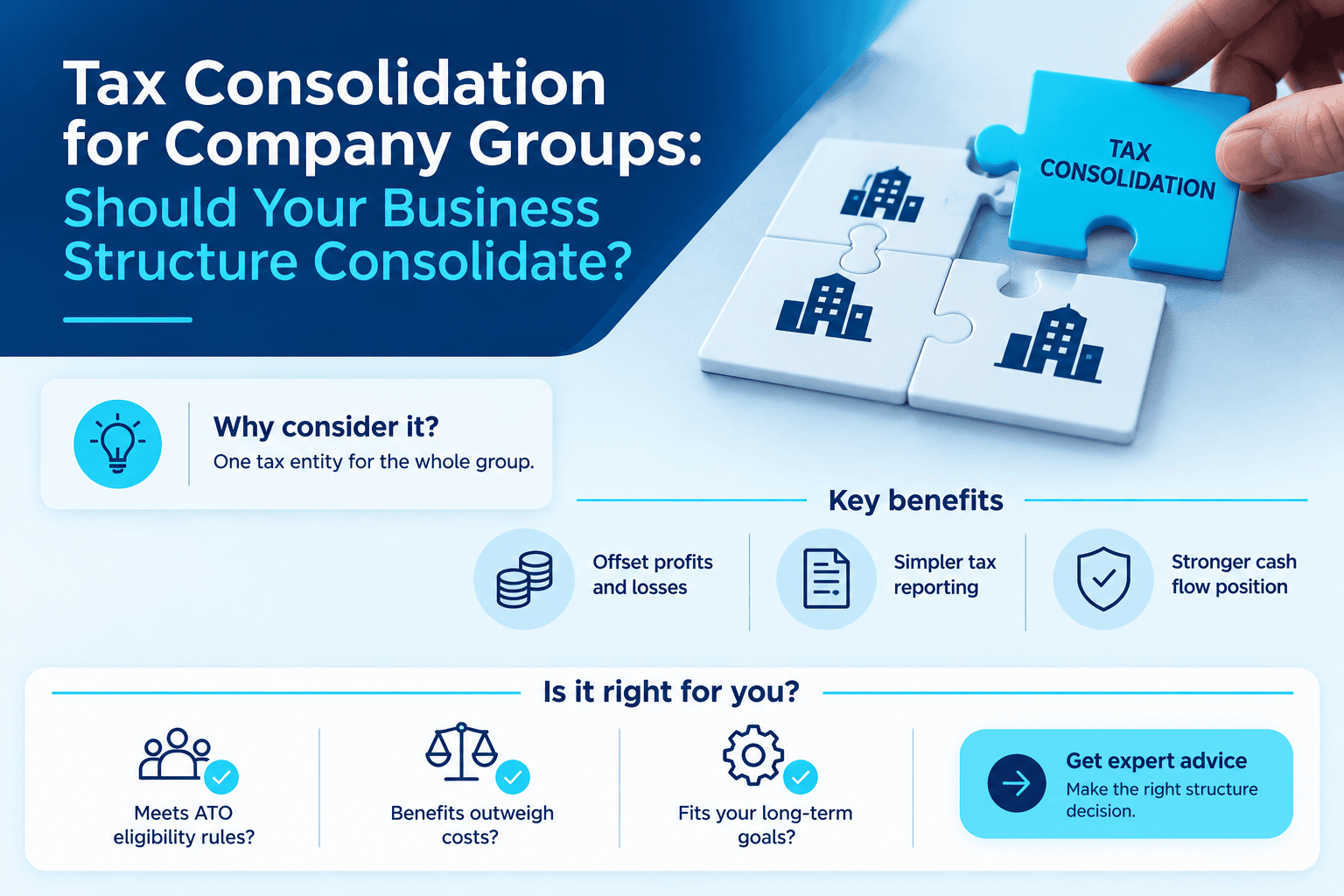
Tax Consolidation for Company Groups: Should Your Business Structure Consolidate?
As a business grows, it's common to end up with several companies under common ownership — a trading entity, a holding company, perhaps a separate entity for a new venture or acquisition. Once that structure exists, a natural question follows: should these entities be tax consolidated, or is it better to keep them separate?
Tax consolidation isn't the right answer for every group, but for the right structure, it can meaningfully simplify compliance and unlock genuine commercial benefits. Understanding both sides is a CFO-level decision, not just a compliance formality.
What Tax Consolidation Actually Means
Tax consolidation allows a group of wholly-owned Australian resident companies to be treated as a single entity for income tax purposes. Instead of each company lodging its own separate tax return, the head company lodges one consolidated return covering the whole group.
Once consolidated, intra-group transactions — including asset transfers, dividends, and loans between group members — are generally ignored for tax purposes, since the group is treated as one taxpayer.
The Potential Benefits

Simplified Compliance
One tax return for the group, rather than separate returns for each entity, can reduce administrative burden and the risk of inconsistencies between related entities.

Tax-free intra-group transactions
Assets, including trading stock and other property, can generally be transferred between group members without triggering tax consequences at the time of transfer — useful for internal restructuring, asset protection, or consolidating operations.

Offsetting losses within the group
Losses in one group member can generally be used to offset profits in another group member, without needing separate loss transfer arrangements between entities.

Single set of franking credits
The group operates with a single franking account, which can simplify dividend planning across multiple entities.

Cleaner structure for future transactions
When selling part of the business, bringing in new investors, or restructuring, a consolidated group can sometimes present a cleaner position than a web of related entities with individual tax histories.
The Trade-Offs and Risks
The election is generally irrevocable Once a group consolidates, unwinding that decision is generally not straightforward — this makes it a decision that warrants careful modelling before committing, not just a "try it and see" approach.
Joint and several liability Group members can become jointly and severally liable for the income tax liability of the consolidated group, meaning one entity's tax debt can become an exposure for the others.
Complexity in the transition year Bringing existing entities into consolidation for the first time requires specific cost-setting calculations (allocating a tax cost to each subsidiary's assets), which can be a technically involved process requiring careful advice.
Not always the right fit If group entities are intended to remain commercially and financially distinct — for future sale, differing risk profiles, or external investment reasons — consolidation may work against that separation, since it merges the group's tax position rather than preserving individual entity histories.
Questions to Work Through Before Deciding
A Structural Decision Worth Modelling Properly
Tax consolidation can be a genuinely valuable simplification for the right group — but because the election is generally irrevocable and carries joint liability implications, it's a decision that benefits from proper modelling against your group's specific structure and future plans, not a default assumption that "one return is always simpler.
RBizz models tax consolidation scenarios for company groups to see whether it genuinely benefits your structure — schedule a free consultation to review your group.