
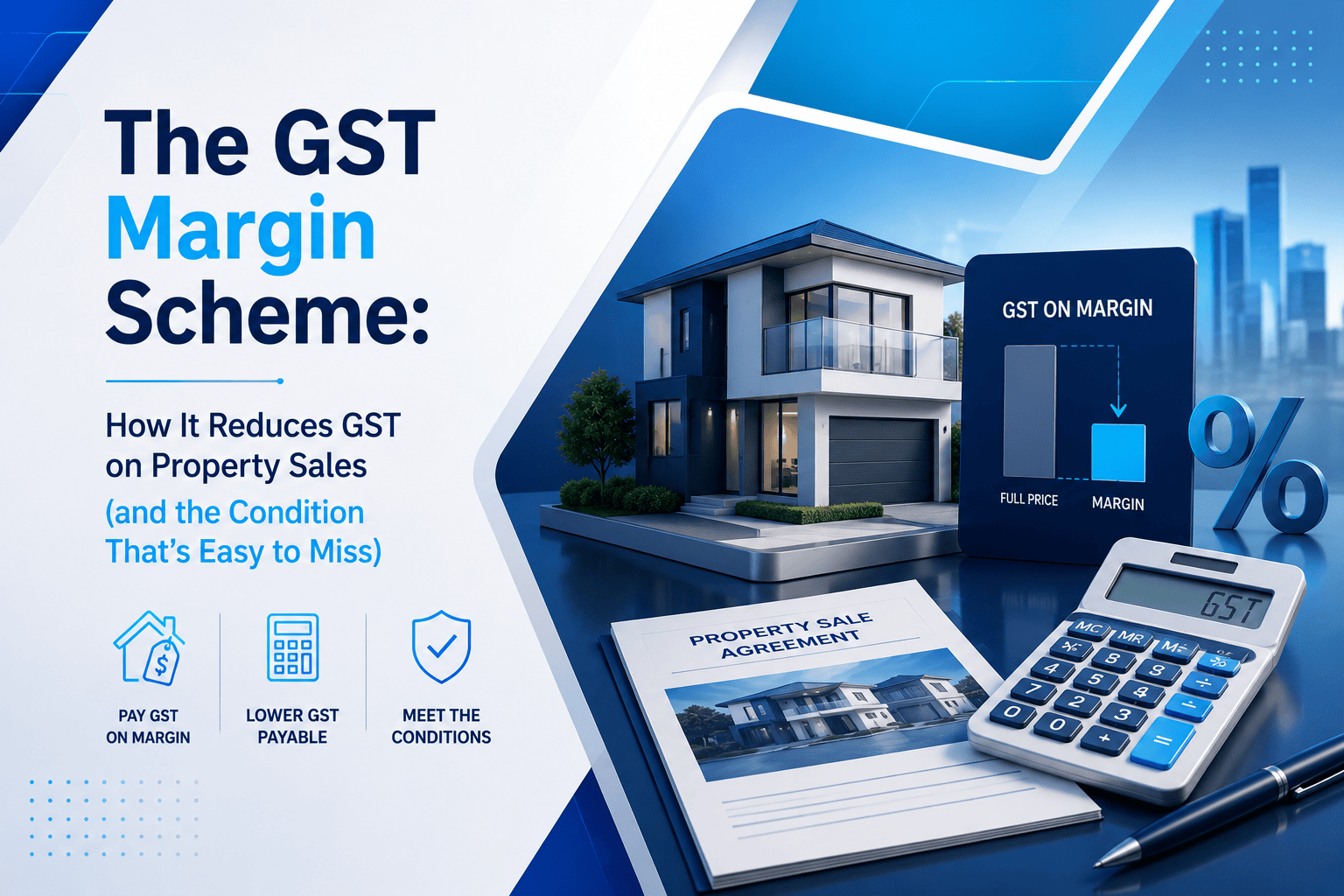
The GST Margin Scheme: How It Reduces GST on Property Sales (and the Condition That's Easy to Miss)
How the Margin Is Actually Calculated
In its simplest form, the margin is calculated as:
Sale price − Original purchase price (or an approved valuation, for property held before GST began or acquired GST-free) = Margin
GST is then calculated on that margin, rather than on the full sale price. For a property with a large embedded gain, this can produce a meaningfully lower GST liability compared to applying standard GST to the entire sale price.
The Critical Condition Most People Miss
The margin scheme must be agreed to in writing between buyer and seller, before or at settlement. This isn't a default treatment you can apply retrospectively, and it isn't something the seller can simply choose unilaterally without the buyer's agreement.
If this written agreement isn't properly in place at the right time, the standard GST treatment applies to the full sale price — and this cannot be corrected after settlement has occurred. Unlike some tax elections that can be fixed through an amendment, a missed margin scheme agreement is not something you can go back and apply retroactively once the sale is complete.
When the Margin Scheme Isn't Available at All
The margin scheme can't be used in every situation. It's generally not available where:
- The property was originally purchased as a fully taxable supply where the seller was entitled to claim the full GST credit on acquisition, and the margin scheme wasn't used on that original purchase (subject to specific rules around this).
- The sale is between associated entities for a price below market value, in certain circumstances, without a proper valuation being used.
Because the availability of the margin scheme depends on the property's specific acquisition history — not just the current sale — this needs to be checked property-by-property, not assumed based on general practice.
Where Property Sellers Commonly Get This Wrong
What to Check Before Your Next Property Sale
Confirm Eligibility and Documentation Before You Sign
Given that a missed written agreement locks in the standard, more expensive GST treatment with no way to correct it later, it's worth confirming margin scheme eligibility and documentation well before contracts are exchanged on a property sale.
RBizz reviews property transactions to confirm margin scheme eligibility and ensures the required written agreement is properly documented before settlement — get in touch before your next property sale.