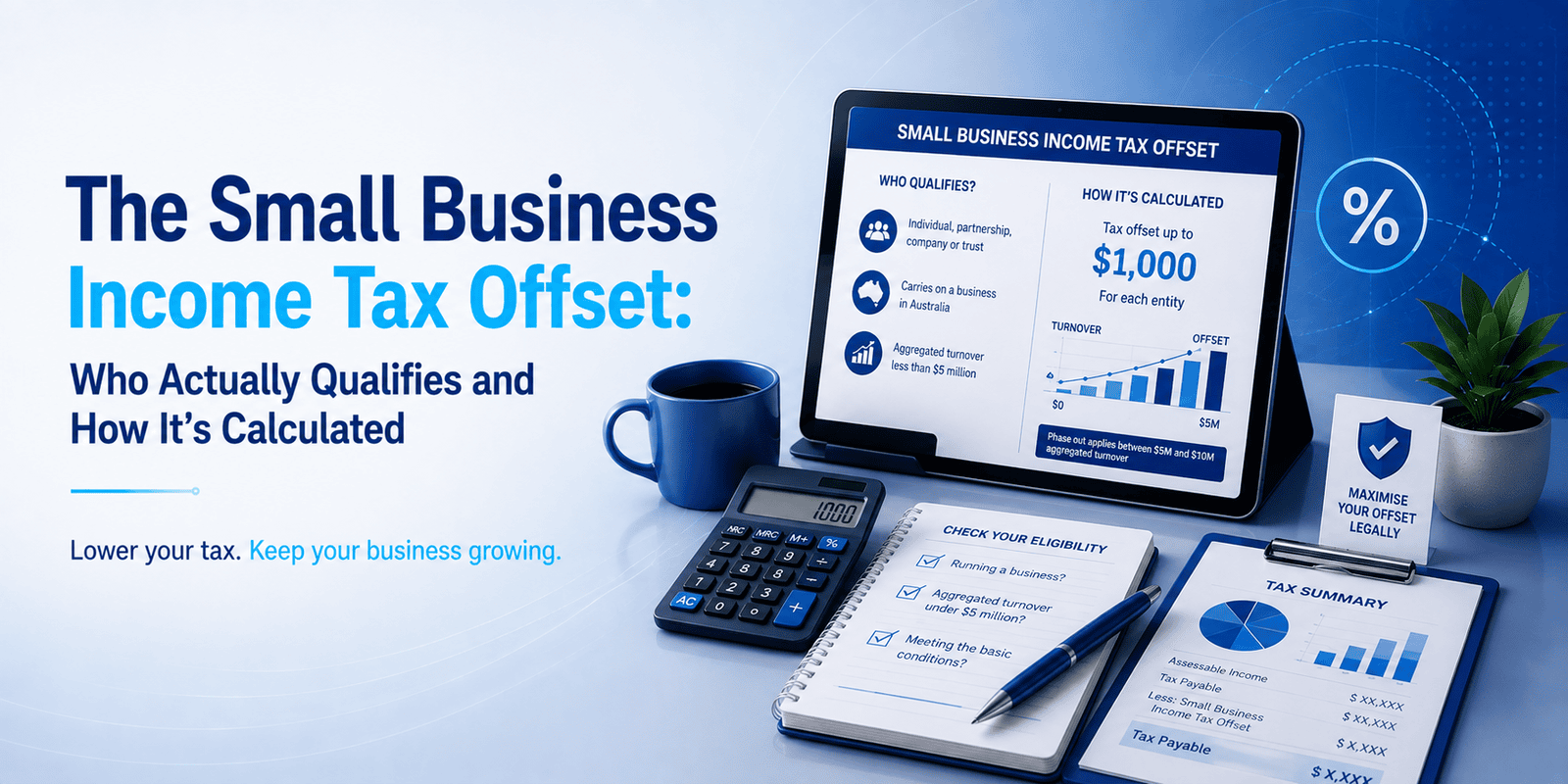
The Small Business Income Tax Offset: Who Actually Qualifies and How It's Calculated
Who Can Actually Claim It
This offset is available to:
- Sole traders running a small business
- Individuals with a share of net small business income from a partnership or trust
It is not available to companies — this offset specifically applies to individuals with business income taxed at their personal marginal rate, which is why it doesn't extend to company structures (companies access a different, separate concessional company tax rate instead).
Eligibility also depends on your business meeting the turnover threshold for the small business definition applicable to this offset. Confirm the current turnover threshold applies to your specific business before assuming you qualify.
How the Offset Is Actually Calculated
The offset is calculated as a percentage (currently 16%, though this rate has changed over time and should be confirmed for the current year) of the income tax payable on your business income — not 16% of your business profit itself. This distinction matters:
Example of the calculation logic (illustrative only — confirm current rate before use): If your net small business income is $50,000 and the income tax payable specifically attributable to that business income (calculated proportionally against your total taxable income) works out to $8,000, the offset would be 16% of that $8,000 tax figure — not 16% of the $50,000 income itself. This produces a considerably smaller offset than people often assume when they first hear "16%" and mentally apply it to their profit figure instead.
The $1,000 cap: regardless of how the percentage calculation works out, the maximum offset available is $1,000 per individual per year. For business owners with meaningful profit, the calculated offset frequently exceeds $1,000 and is simply capped there — meaning above a certain income level, the offset stops scaling with profit at all.
Common Mistakes
What This Means in Practical Terms
What to Check on Your Own Return
Make Sure You're Actually Claiming This
This offset is often applied correctly by tax software and registered agents as a standard part of preparing an eligible return, but it's worth confirming it's been applied to your return at all, and that the underlying calculation reflects your correct business structure and turnover position.
RBizz confirms small business offset eligibility and calculation accuracy as part of every eligible client's return — get in touch to check yours has been applied correctly.