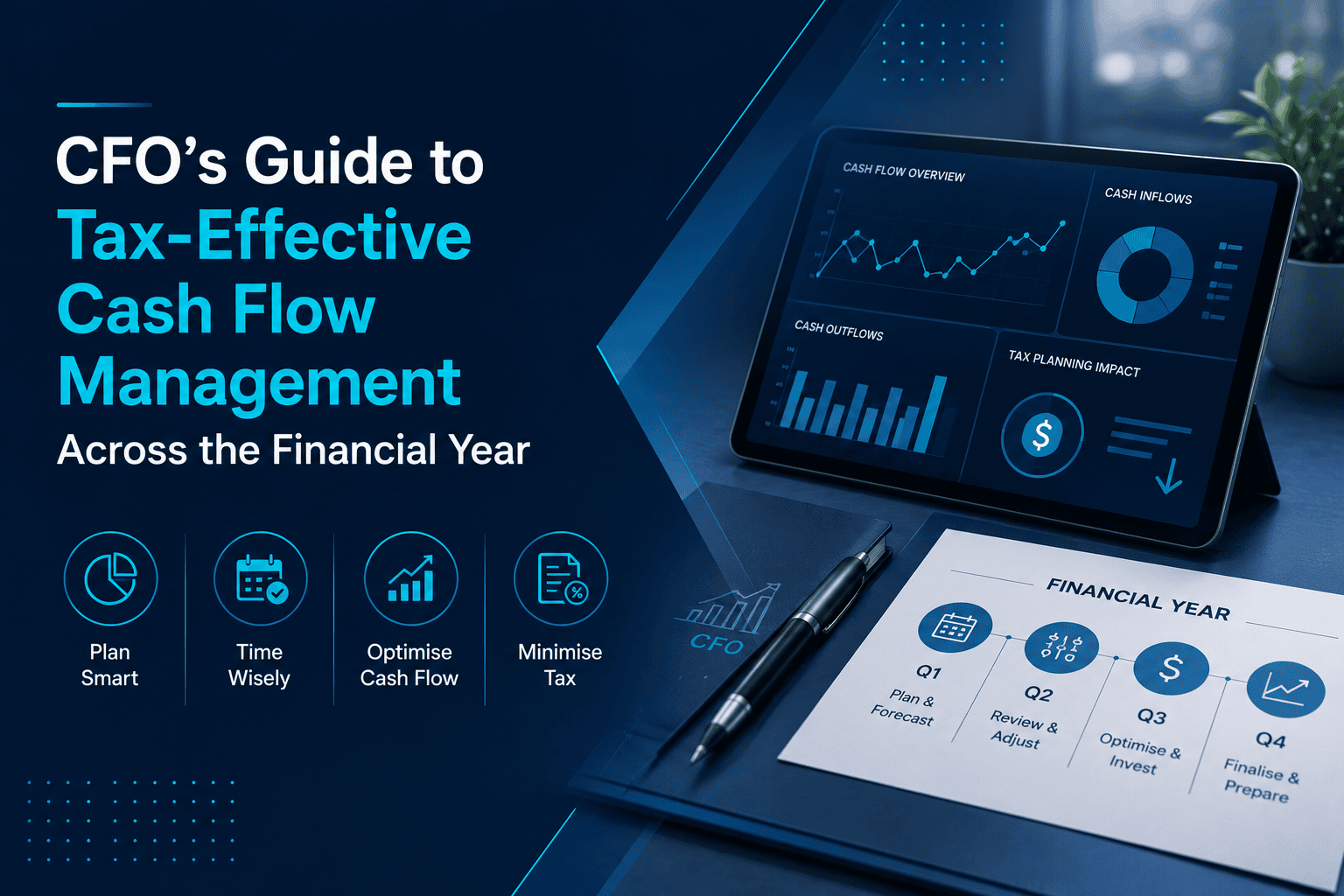
CFO's Guide to Tax-Effective Cash Flow Management Across the Financial Year
Why Tax Obligations Create Uneven Cash Flow Pressure
Several obligations land on a recurring quarterly or annual cycle:
- BAS and GST payments, due quarterly or monthly depending on your reporting cycle.
- PAYG instalments, based on either an ATO-calculated amount or a rate applied to actual income, which can create a mismatch if the business's revenue pattern is seasonal.
- Superannuation Guarantee contributions, due quarterly, and increasingly time-sensitive given deduction timing depends on payment being made within the correct financial year.
- Payroll tax, where applicable, often on a monthly reporting cycle with an annual reconciliation.
- Income tax on lodgment, which can create a large single payment obligation depending on the business's lodgment program and prior-year instalment accuracy.
Individually, each of these is manageable. Stacked together in the same month — which happens more often than businesses expect — they can create a cash flow squeeze that has nothing to do with the underlying profitability of the business.
Building a Tax-Aware Cash Flow Model
1. Map every recurring obligation onto a single calendar
Rather than tracking BAS, PAYG, super, and payroll tax separately, consolidate them into one forward-looking calendar showing exactly when each payment falls due across the full financial year. This makes clustering visible months in advance, rather than being discovered a week before a payment is due.
2. Separate tax funds from operating cash
A dedicated tax reserve account — funded progressively as revenue comes in, rather than drawn down only when a payment is due — removes the temptation to treat GST collected or PAYG withheld as available operating cash, when it's effectively already earmarked for the ATO.
3. Reassess PAYG installments against actual performance
If revenue is tracking materially above or below the instalment rate's assumption, a variation request can better align the instalment amount with actual current-year performance, avoiding either a large refund tied up until lodgment or an underpayment shortfall building up.
4. Build super payments into payroll cash flow, not as an afterthought
Since super is calculated as a percentage of wages and paid quarterly, it should be modelled as a standing payroll-linked obligation, not a separate item reviewed only when the due date approaches.
5. Factor in lodgment-based tax payments separately from instalments
Where the final tax liability differs materially from instalments paid throughout the year, that gap needs to be anticipated well before the lodgment deadline — not identified as a surprise once the return is finalised.
Where CFOs Commonly Get Caught Out
The Commercial Value of Getting This Right
Building Your Forward Tax Calendar
If your business doesn't already have a consolidated view of every tax obligation across the financial year, building one is one of the highest-value, lowest-effort improvements available to a CFO — it turns a recurring source of cash flow stress into a predictable, planned-for line item.
RBizz works with CFOs to build tax-aware cash flow models that remove the quarterly guesswork — schedule a free consultation to review your forward calendar.