
Blog by RBizz Team

Most partnership and shareholder agreements are signed once and never reread — until a dispute reveals that what everyone assumed it said and what it actually says are two very different things.
RBizz Team
31/08/2026 12:27 PM - Comment(s)

The 2025-26 fringe benefits tax year ended on 31 March. As employers gear up for FBT tax time, there are a few changes for 2025-26 that employers should be aware of, especially if you provide plug-in hybrid electric vehicles (PHEVs) to your employees.
RBizz Team
29/08/2026 11:25 PM - Comment(s)

2026-27 Federal Budget was ambitious, announcing significant reforms to capital gains tax and negative gearing in a bid to support home ownership and improve the fairness of the tax system.
RBizz Team
29/08/2026 11:25 PM - Comment(s)

“Q: Why do I need an evolving strategy for my small business?”
You’re a business owner or CEO. And that means it’s your responsibility to take care of the business, invest in the right places and make the company a success story.
However, to do this, you need an agreed business strategy that lays out...
RBizz Team
29/08/2026 11:24 PM - Comment(s)

Alongside changes to the CGT rules, the Federal Budget announced that the availability of negative gearing would be curbed for residential property investors. Properties purchased from 1 July 2027 will be subject to the new rules.
RBizz Team
29/08/2026 11:24 PM - Comment(s)

Equity granted to employees isn't taxed like ordinary salary, and startups often assume any equity grant automatically qualifies for concessional treatment without checking the actual eligibility criteria.
RBizz Team
29/08/2026 11:23 PM - Comment(s)
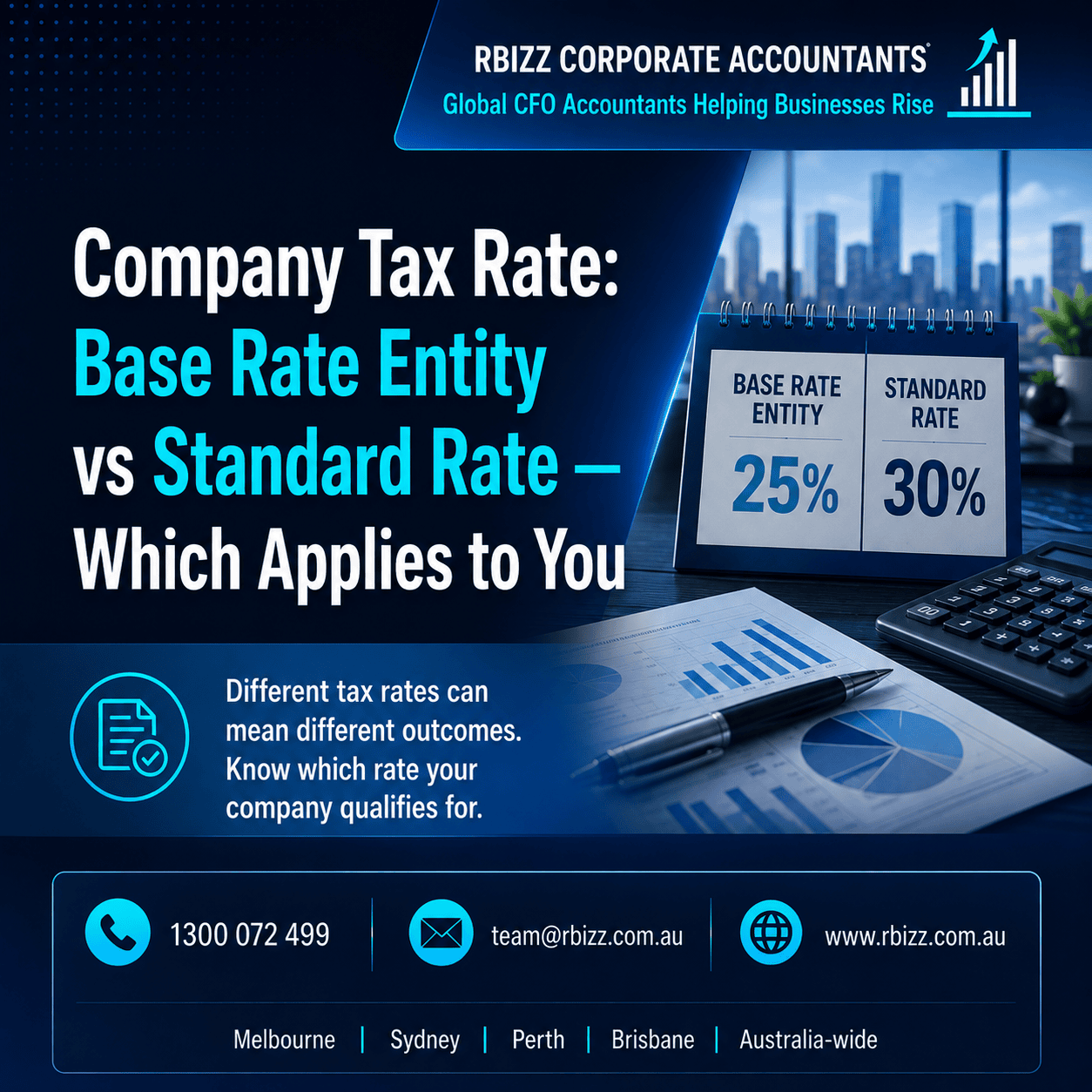
Companies must pass both an aggregated turnover test and an 80% passive income test to access the lower 25% rate, and both need to be checked every single year — not assumed to carry forward.
RBizz Team
29/08/2026 11:23 PM - Comment(s)

Cyber insurance policies vary significantly in scope, and exclusions like unmaintained security standards, social engineering scams, and prior known vulnerabilities can leave businesses without coverage exactly when a claim matters most.
RBizz Team
29/08/2026 11:23 PM - Comment(s)

An accountant who never pushes back isn't a sign of a flawless business — it's usually a sign they're processing your numbers rather than genuinely engaging with your decisions.
RBizz Team
29/08/2026 11:23 PM - Comment(s)

Profit and cash are fundamentally different measures, and the gap between them — unpaid invoices, inventory, loan principal, GST timing — is exactly what catches profitable businesses off guard when the bank balance doesn't match the P&L.
RBizz Team
29/08/2026 11:22 PM - Comment(s)

Blaming a weak quarter on "the slow season" can quietly mask a real margin problem — the giveaway is a seasonal dip that's getting worse each year rather than staying consistent.
RBizz Team
29/08/2026 11:22 PM - Comment(s)

Businesses blame slow sales on marketing spend, but the real revenue leak is usually invisible — leads that never got a proper second follow-up, costing far more than any ad budget would show.
RBizz Team
29/08/2026 11:22 PM - Comment(s)
A large tax refund feels like good news, but it almost always means you overpaid throughout the year and got nothing for the government holding your money in the meantime — the real fix is recalibrating PAYG instalments, not celebrating the refund.
RBizz Team
29/08/2026 11:21 PM - Comment(s)

A dominant client feels like a win, but heavy revenue concentration quietly erodes pricing power and decision-making independence, and it's often the first thing that spooks lenders or buyers when the business needs financing or a sale.
RBizz Team
29/08/2026 11:21 PM - Comment(s)

A healthy retained earnings figure on the balance sheet isn't sitting cash — it's usually already tied up in assets, debt repayment, or growth, and directors who draw dividends against that number without checking actual cash flow can be in for a real surprise.
RBizz Team
29/08/2026 11:21 PM - Comment(s)

Most businesses that come out of an ATO review poorly weren't doing anything wrong — they simply couldn't prove, years later, that a genuinely correct decision was actually made at the time.
RBizz Team
29/08/2026 11:21 PM - Comment(s)

A packed schedule feels like proof of success, but revenue, margin, and cost can all move in the wrong direction while activity increases — and busy is instantly felt while growth only shows up when you actually check the numbers.
RBizz Team
29/08/2026 11:20 PM - Comment(s)
Most "competitively priced" businesses haven't actually calculated their real costs — they've just matched a competitor's number without checking whether it covers their own overhead, labour, and cash flow.
RBizz Team
26/08/2026 12:49 PM - Comment(s)

Serious financial and compliance problems rarely start big — they start small and compound quietly in the "eventually" pile until the fix that used to be simple is no longer available at all.
RBizz Team
24/08/2026 11:46 AM - Comment(s)

The small business restructure rollover lets eligible businesses change legal structure without an immediate CGT hit, provided the same owners retain economic ownership and the change is timed separately from any actual sale.
RBizz Team
23/08/2026 12:23 AM - Comment(s)
Categories
- News Alerts
(103)
- Templates
(2)
- Guides
(283)
- Blogs
(161)
- Courses
(0)
- Health Checks
(0)
- Calculators
(0)
- Videos
(0)
- Compliance
(65)